Case study
Optimizing the customer journey with a digital ecosystem
An example of Digital Transformation aimed at fostering collaboration among various company departments, with the goal of optimizing the Customer Journey and integrating it into a unified ecosystem.

How to Improve Cross-Department Collaboration to Build an Integrated User Experience
Recently, we were approached by a client—an important automotive company structured into multiple subsidiaries and departments—to support them in creating a product that impacts various business areas.
We started with a series of interviews to better understand the needs of the different stakeholders involved. We quickly realized that the goal was to develop a service allowing users to seamlessly “navigate” within a single, integrated digital ecosystem that connects the services offered by the different companies within the group.
The key challenge was facilitating collaboration between sales, marketing, customer service, and finance teams to align their diverse requirements, ultimately creating a fully integrated Customer Journey.
Initial context
A major automotive company, divided into multiple subsidiaries and departments, sought support in developing a product that would impact all its business areas.
Client’s needs
To create a service that allows users to “navigate” within a single, integrated digital ecosystem, involving departments such as sales, marketing, customer service, and finance to ensure a consistent and seamless user experience.
Product inception: from vision to backlog
In Product Management, a product must meet the needs of the end user. Defining these needs from the outset is therefore essential to building a successful product. Over the years, we have developed a process designed to guide our clients through a journey that, starting from an initial definition, leads to the creation of the product backlog, i.e., the list of needs translated into the product’s final functionalities.
In our approach, the product inception process is based on three main phases:
- Vision: The product vision provides a general idea of what is to be achieved and what problems it aims to solve.
- Personas: Personas are defined to understand the needs of the target customer segments, outlining demographic characteristics, behaviors, and business requirements.
- Customer Journey: For each business need, a Customer Journey is created, describing how the customer interacts with the product and the company.
Through the definition of the Customer Journey, we aim to simulate user behavior, ensuring that interaction with the product effectively addresses their business needs.
In this particular case, we had to create a Customer Journey that outlined user behavior within a digital ecosystem, where multiple digital products interact to deliver a cohesive and seamless user experience.
Below is what we did.
Customer journey for digital ecosystems
In a digital ecosystem, due to the presence of multiple products that need to interact, there are essentially different Customer Journeys that must be merged to create a consistent user experience across all ecosystem products.
To achieve this goal, we developed a model based on the metaphor of resource exchange (primarily services and data). For this reason, we named it Digital Bazar.
Digital Bazar
An example of a customer journey
To create a Customer Journey, we often organize a workshop where we bring together representatives from different companies within the same group. Instead of just sitting around a table, we prefer standing in front of the same walls, mapping out insights to share different perspectives and understand the interconnections between various Customer Journeys.
This is exactly what we did with the heads of sales, marketing, customer service, and finance from our automotive client. During this phase, for each step of the different Customer Journeys, we collect and generate various types of data that can serve as input/output across user journeys.
For example, the user journey for purchasing a vehicle might follow these steps:
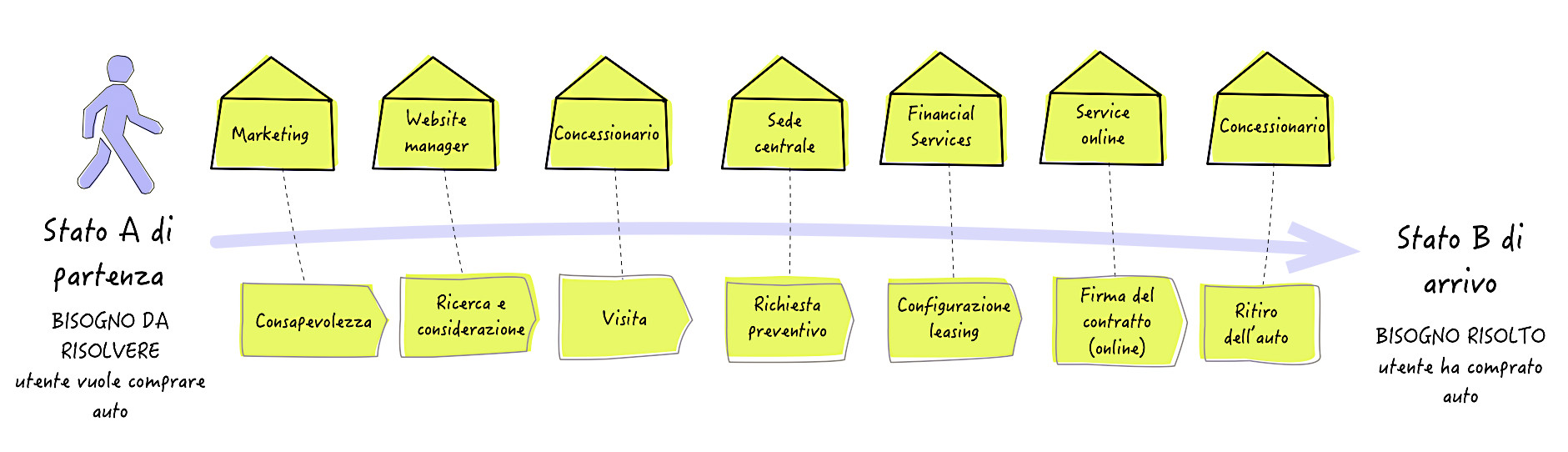
The journey from point A to point B is often the result of multiple sub-journeys, which can be interconnected through data exchange and composition.
From this example, we can see how financing configuration data and leasing contract details are valuable across multiple departments in an automotive company.
- Finance Department: Monitors approvals and cash flow.
- Sales Department: Evaluates strategy effectiveness and identifies popular car models.
- Marketing: Designs targeted campaigns and optimized strategies.
- Customer Service: Provides personalized support.
- Strategic Planning & Analysis: Drives business decisions.
- Risk Management & Compliance: Assesses risks and ensures legal compliance.

Why did we start with data?
At first glance, the connection mechanism between user journeys might seem complex, but in reality, it’s much closer to the daily experience of our clients than it appears.
Talking about cross-departmental Customer Journeys can feel abstract or even esoteric. However, reframing the conversation with practical questions makes the concept much more tangible: “What information and services do you need to complete this task?”, “At the end of your process, what data or outputs do you generate that could be valuable for someone else?”, “What services can you offer based on your expertise and responsibilities?”.
To facilitate this exchange, we organized barter sessions, where participants discussed their needs and offers in terms of data and services.
Interestingly, the most valuable outcome of these sessions wasn’t purely technical (i.e., connecting journeys), but rather social and political: we successfully established connections between supply and demand and we fostered collaboration across different departments, breaking down silos between teams, offices, and even separate companies.
So… Customer journeys in digital ecosystems
Thanks to the Digital Transformation efforts, the company successfully created an integrated ecosystem that significantly enhances the user experience. Collaboration between various departments led to greater internal cohesion and an overall improvement in business operations.
The process strengthened the sense of community and teamwork, boosting morale and job satisfaction, as employees felt like an integral part of a meaningful and successful transformation.

Our stories

Agile Mindset: a story from the banking industry
The agile principles applied in a financial institution that follows strict regulations. Even in this highly regulated environment, Agile principles were applied and our clients goals were achieved.
Discover more Discover more
Agile scaling in a telecom company
A case study from a complex structure organisation. Design, support, engagement and participation.
Discover more Discover more
Agile principles at the service of energy sustainability
An alternative solution in support of design wind turbines.
Discover more Discover more
Optimizing the customer journey with a digital ecosystem
The core focus of this project, carried out for a client in the automotive sector, was to enable collaboration between different departments—sales, marketing, customer service, and finance—bringing together their diverse needs to create an integrated Customer Journey (user experience).
Discover more Discover more
Innovation workshop: facilitation fuels the forge of ideas
A facilitation workshop to meet the client's need for support in creating moments of dialogue between people and fostering collaboration.
Discover more Discover more
Agile in the large-scale retail trade
gile tools and mindset supporting HR, Organization Design, and Initiative Portfolio in large-scale retail.
Discover more Discover more